When the spreadsheets stop agreeing
The opportunity with Oracle APEX 26.1 is to spend less time assembling standard pages and more time testing the workflow that matters. Blueprints provide the scaffold; APEXlang makes application changes reviewable as source. That can bring a working first iteration forward without treating generated screens as a finished clinical system.
Imagine a sponsor auditor asking a research site a narrow question: on 14 March, who was delegated to perform a task, and was their required training current that day?
A delegation log and a training matrix might each look complete. But if both are edited in place, reconstructing how they agreed on a particular date becomes harder than finding today’s entry.
The same problem appears elsewhere: visit trackers use different protocol versions, finance works from copied procedure lists, and an updated spreadsheet does not explain which historical decisions changed.
This is where a shared application becomes useful. The goal is not merely to replace Excel. It is to connect the rules, events and records that need to agree.
About the screenshots: All screenshots use test data.
Why Oracle APEX fits the problem
For an organisation already using Oracle Database, APEX offers a way to build around existing data and reviewed PL/SQL rather than first introducing a separate data platform.
The proposed application covers protocol and visit scheduling, delegation and credentialing, essential records, monitoring and corrective actions, investigational product accountability, subject management and finance. The workflows below illustrate how those responsibilities connect.
APEX supplies application components. The study rules, historical data model and controls remain application-specific engineering work. Fewer technologies can simplify operations, but the number of tiers is not proof that software is easier to validate or fit for clinical use.
A faster rollout starts with a smaller first release
Here is an illustrative six-week delivery plan for one bounded workflow, such as delegation review or draft accrual review, using synthetic data in a test environment. It assumes an experienced APEX developer, an available business owner and quality reviewer, an existing Oracle environment, agreed data structures and no major external integration. It is a planning example, not a reported client result, benchmark or guaranteed schedule.
| Target period | Focus | Reviewable result |
|---|---|---|
| Week 1 | Agree scope, risks and acceptance criteria | One workflow, approved rules and representative test cases |
| Week 2 | Generate and refine the scaffold | Working pages and navigation ready for stakeholder feedback |
| Weeks 3-4 | Implement rules and controls | Tested permissions, history, exception handling and workflow logic |
| Weeks 5-6 | Run a test-environment pilot | User feedback, test evidence and a prioritised list of release gaps |
| After the pilot | Decide production readiness | Quality-led validation, training, operational checks and release approval |
The speed advantage is earlier feedback on working software and less repetitive page construction. It is not a promise to deliver all seven modules, migrate historical records and validate a multi-site clinical platform in six weeks. Production timing depends on the gaps the pilot reveals, integrations, data readiness and the organisation’s approval process. Add sites and modules in controlled phases after the first workflow is accepted.
For finance, define the baseline before rollout: time spent preparing invoices, eligible activity missed, held lines and duplicate accruals. Review the first complete billing cycle after an approved release, then track subsequent cycles. Additional accruals are not recovered cash; any revenue or payback claim needs reconciled invoices and payment evidence. No historical revenue-recovery result is claimed here.
Three connected workflows
1. Visit conduct: derive the schedule and retain its history
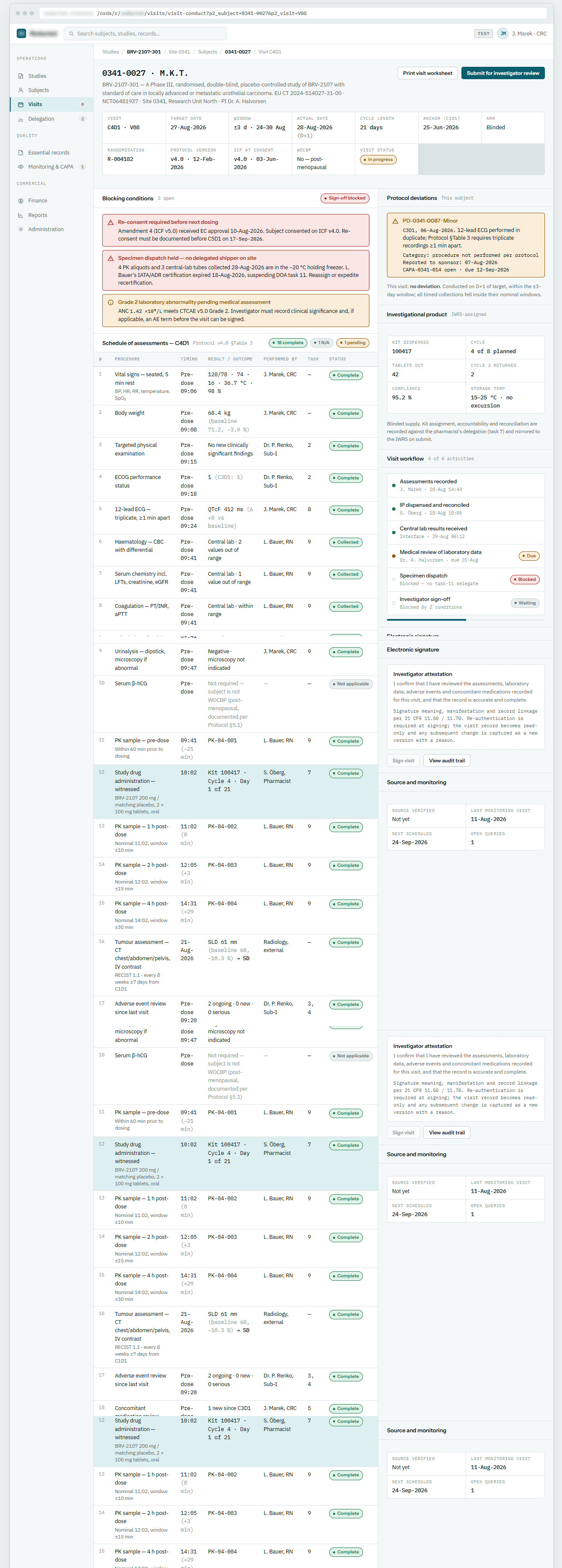
The visit view brings together the subject, visit window, protocol context, procedures and outstanding conditions. Each procedure needs a record of who performed it and the authority under which they acted.
Visit windows should be calculated from approved protocol rules and the relevant anchor event, rather than typed independently into a tracker. The application also needs an explicit rule for which protocol or amendment applies to each participant. Consent date alone should not be treated as a universal rule for all studies.
When an amendment changes a schedule, retain the previous version, the reason, effective date and approval. Show the impact before applying it; do not silently rewrite completed visits. This is an operational design pattern, not guidance on clinical scheduling or treatment decisions.
2. Delegation: connect authority to current qualifications
The delegation model links a study task to a person, an effective period and the training that supports it. The visit screenshot illustrates why this matters: sample collection and sample shipment are separate permissions, so losing one qualification need not remove unrelated authority.
The important implementation detail is checking authorisation when an action is performed, not only when a page is opened. A scheduled expiry process and server-side checks should agree, with a defined escalation path for exceptions.
Historical records must remain understandable after a qualification expires. Today’s status should not retroactively change who was authorised at the time of an earlier visit.
3. Finance: trace a draft invoice back to performed work
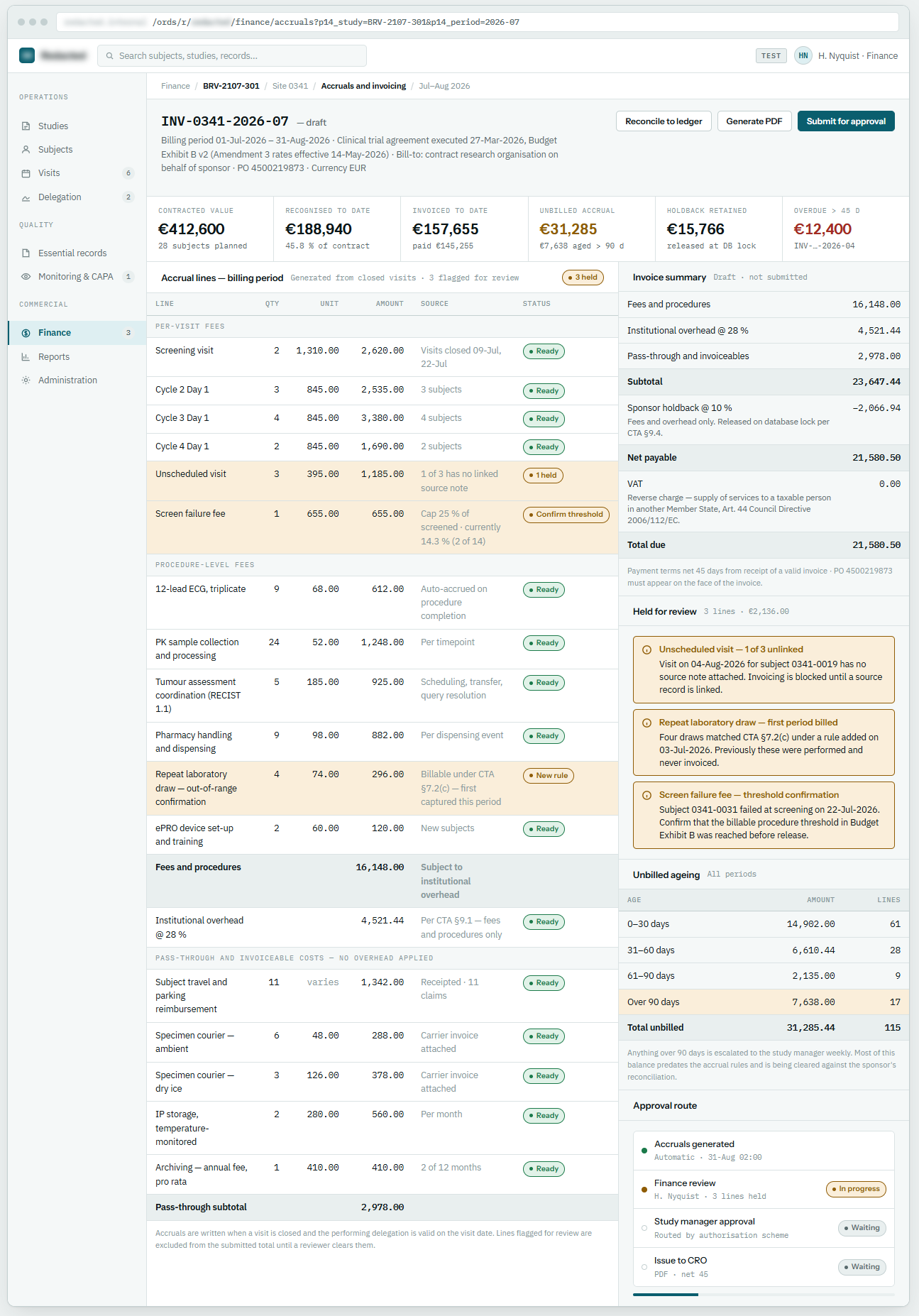
The finance view connects procedure events with contract rates, accrual lines and sponsor invoices. It also makes held lines visible before submission.
This is useful for repeat procedures, unscheduled visits and pass-through expenses that are easy to miss when finance reconstructs activity at month-end. But performed does not automatically mean billable: the applicable contract version, evidence, limits and review state must determine eligibility.
Every accrual should have a source event and a rate version. Corrections should create traceable adjustments, and duplicate processing must not create duplicate charges. Finance can then review a draft instead of assembling the record from disconnected files.
The displayed figures and commercial terms are test data, not a revenue-recovery result or tax recommendation.
What APEX 26.1 changes in the build process
Blueprints provide a starting structure
Oracle’s blueprint workflow takes a functional specification and schema metadata as inputs to a structured application plan. APEX can import the resulting blueprint and generate a scaffold with common pages and components.
For this design, those inputs would describe the schedule of assessments, delegation model, accrual rules and approval paths. The scaffold is a starting point; complex business logic, security and exception handling still need implementation and testing. Oracle’s blueprint walkthrough makes that distinction explicit.
APEXlang makes changes reviewable
APEXlang represents application definitions as human-readable source. Developers and coding assistants can work on those files in a repository, with review and validation before import.
APEX 26.1 also extends Static IDs across components to reduce misleading differences between exports. Static IDs are not an entirely new concept in APEX. The 26.1 release notes document the expanded use and associated comparison improvements.
A practical development loop is: agree requirements, generate a scaffold, refine the source, review changes, validate the definition, then test behaviour in a controlled environment. The business analyst and quality team remain part of that loop. An AI assistant does not decide protocol rules, billability or whether evidence is sufficient for release.
Use AI within explicit data boundaries
Development-time assistance and runtime AI are different decisions.
APEX 26.1’s natural-language support for Interactive Reports interprets requests as report settings, such as filters, sorting, breaks and charts, using the report’s existing columns and capabilities. This is distinct from giving a model unrestricted authority to compose queries against subject data. Oracle’s Interactive Report documentation
That distinction does not, by itself, establish privacy. Review prompts, report context, reference data, model endpoints and logs before enabling AI on sensitive workflows. A privately hosted model can be part of that design, but the endpoint location alone cannot prove that nothing leaves the environment.
Protocol summaries or monitoring follow-up drafts should remain drafts for qualified review, not autonomous changes to authoritative records. Our local AI article discusses the infrastructure and performance trade-offs separately.
Reviewable source is not clinical validation
Git history can show what changed. Compiler validation can check an application definition. Neither proves that a configured system reliably meets its intended clinical use.
The EMA’s guideline on computerised systems and electronic data in clinical trials addresses validation and the responsible party’s continuing obligations. ICH E6(R3) Principles and Annex 1 became effective in the EU on 23 July 2025. Applicability of US electronic-record requirements depends on the records and regulated use; it is not established simply because an application serves a research site. See the FDA’s clinical electronic-systems guidance.
For a real implementation, the quality-led release process should connect approved requirements to risk assessment, test evidence, deviations and release approval. Access controls, audit history, electronic signatures where applicable, backup and restoration, retention, and operating procedures all require attention.
A database-backed audit design can support that work, but calling it immutable requires evidence about permissions and every supported write path. This walkthrough is an engineering illustration, not a regulatory compliance determination.
Build the part that is specific to the operation
Before commissioning software, assess whether an existing site-management product can meet the requirements. Custom development makes sense when important costing rules, visit logistics or delegation workflows cannot be handled adequately through configuration.
A useful first phase is one well-defined workflow with agreed acceptance criteria and a representative test dataset. Measure the work required to refine, validate and operate it before committing to a full rollout.
Send hello@nwavecloud.com the workflow you want to replace, its main rules and any integration requirements. That gives us a starting point for a scoped proposal and delivery estimate, rather than a generic promise about an entire platform.
For the development side, explore nwavecloud Build. For the runtime platform, see the Cloud Hosting overview. Hosting and development support the delivery process; they do not replace the organisation’s responsibility for its clinical systems.