The short version
In our experience, dashboard pages are the chattiest pages in an APEX application. A filter changes, and every chart, card list and grid asks the server for new data, one Ajax request each. APEX 26.2 adds a method that bundles those requests:
apex.region.multipleRefresh( ["chart1", "chart2"] );- One request where possible. Chart, Cards, Interactive Grid and Template Component report regions in the list are refreshed together with a single Ajax request.
- Separate requests for the rest. Other regions can be in the same list; each sends its own request.
- One promise. It resolves when all the requests are complete.
- Initial load too. With chart Lazy Loading on, the
manualLoadingoption lets a page fetch the first data of several charts in one request.
What Oracle shipped in 26.2
The release notes call the feature Coalescing Refresh Requests. Some regions that get their data in JSON format can now be refreshed together with one Ajax request, which Oracle describes as useful for “dashboard style pages” that refresh several regions without reloading the page.
Four region interfaces support it: chartRegion, cardsRegion, interactiveGrid and templateReportRegion, and each API page now says so. templateReportRegion is the interface for Template Component report regions, which is why the chart section of the release notes names Template Component regions. You can pass any combination of the four, and other regions too; those simply send separate requests.
The feature sits next to other chart work in 26.2: a new Lazy Loading property, APIs to start, stop and set the chart refresh interval, a new ForegroundTimer class, and a documented chartRegion interface, where charts previously relied on the generic region documentation.
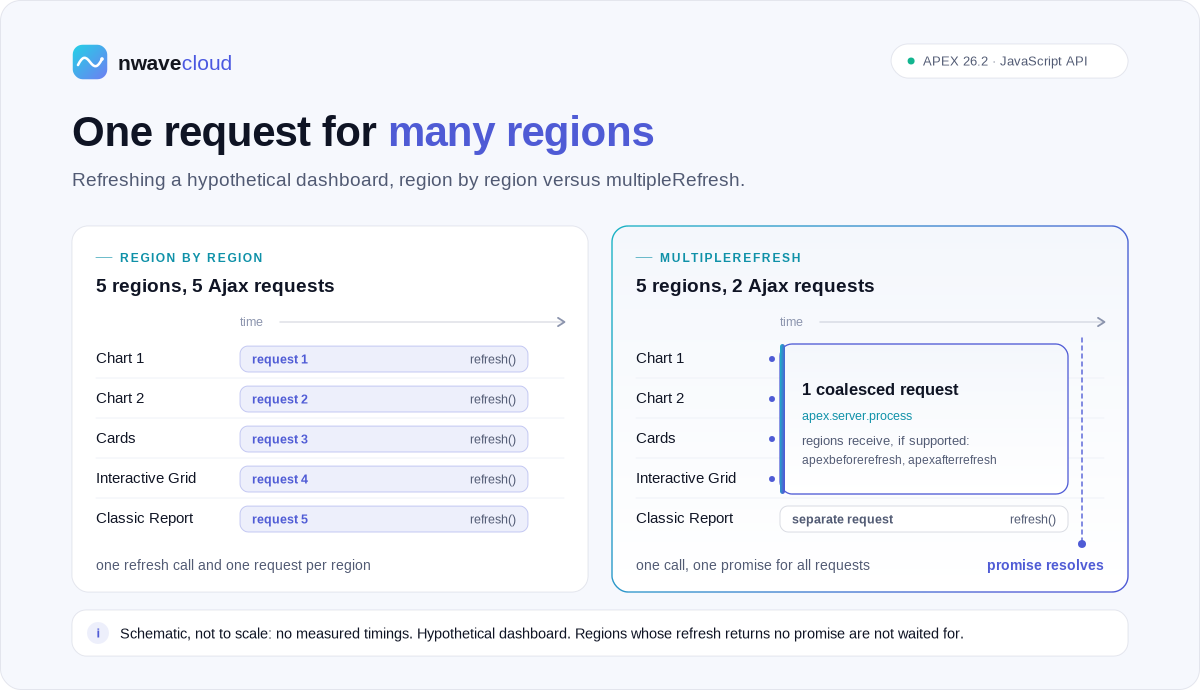
How multipleRefresh works
The signature is multipleRefresh(pRegions, pOptions), a static method on the apex.region namespace.
pRegionsis an array of region HTML DOM ids or region interfaces.- Regions that support coalescing go into one request made with
apex.server.process. - Every other region is refreshed by calling its own
refreshmethod, which sends its own request.
Which regions share the request
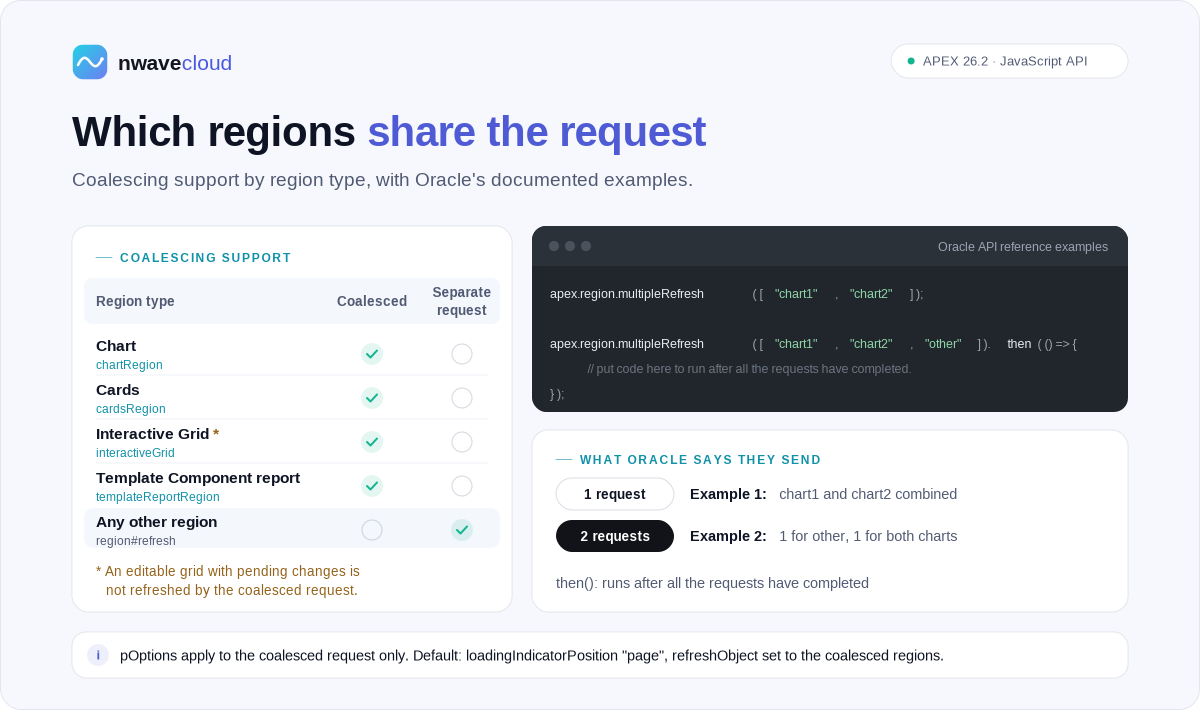
Any region not on the list, a Classic Report or Interactive Report for example, is refreshed the old way inside the same call. Keep in mind that not every region supports refresh at all; the generic region interface says exactly what happens depends on the region type.
The Interactive Grid has one rule worth knowing before you put it on a dashboard. If an editable grid has pending changes, a coalesced refresh does nothing to it. Otherwise its current view joins the request, and its other views are cleared so they fetch new data when next activated. Calling the grid’s own refresh behaves differently: the user gets a warning about outstanding changes and can choose. As we read it, unsaved edits survive a coalesced refresh, but the grid also stays stale, and the documentation mentions no warning in that case. If users edit on your dashboard, save first or treat the grid separately.
The promise
multipleRefresh returns a promise that resolves when all the Ajax requests are complete. This is Oracle’s second example, with the non-coalescing region other in the list:
apex.region.multipleRefresh( ["chart1", "chart2", "other"] ).then( () => {
     // put code here to run after all the requests have completed.
} );
Oracle states that this sends two requests: one for other, one for both charts combined.
One catch: regions whose refresh method does not return a promise are not included in the completion promise. The region interface says a refresh can and should return a promise, but whether it does depends on the region or plug-in. Cards and Template Component report regions document a promise that resolves when the refresh is complete. A chart returns a promise, or null if its component is not yet initialized. For anything outside the coalescing list, plug-ins especially, check before you rely on .then().
pOptions, refreshObject and the refresh events
pOptions is passed to apex.server.process for the coalesced request only. It does not affect the separate requests, and because the request covers several regions, Oracle warns that some options may not apply.
Two defaults matter:
loadingIndicatorPositionis"page", which inapex.server.processmeans one loading indicator in the center of the page.refreshObjectis set to a jQuery collection of the coalesced regions if you do not set it, so each region receivesapexbeforerefreshandapexafterrefreshif it supports them. Those events are equivalent to the Before Refresh and After Refresh dynamic action events. Set your ownrefreshObjectand, by theapex.server.processrules, the events fire on your element instead.
Oracle’s event example fits a dashboard well: it disables a button with id B1 while any refresh is in progress.
apex.jQuery( "body" ).on( "apexbeforerefresh", function() {
    apex.jQuery( "#B1" ).prop( "disabled", true);
} ).on( "apexafterrefresh", function() {
    apex.jQuery( "#B1" ).prop( "disabled", false);
} );
Dashboard pattern: refresh after a filter change
Take a hypothetical sales dashboard: two charts, a Cards region, a read-only Interactive Grid and a Classic Report, all filtered by the same page items. Refreshed one by one, that is five requests. With multipleRefresh and the regions’ DOM ids in one array, it is two: one for the charts, cards and grid, one for the report. Oracle’s API reference calls it a best practice to give a region an HTML DOM id when JavaScript uses it; otherwise APEX generates one internally.
Our view: coalescing reduces the number of requests, not the work each region’s query does. A slow chart query is still slow, so tune the SQL first.
Initial load: Lazy Loading and manualLoading
This is where Oracle’s documentation explicitly connects the two features.
The new chart Lazy Loading property decides when chart data is retrieved: during server-side page rendering, or asynchronously when the page loads and the region becomes visible. It remains enabled by default for existing applications. Lazy charts wait until visible to initialize and request data, so initial chart display can suffer on pages that control chart visibility outside the supported declarative techniques (Region Display Selector with sibling regions, Tabs Container and Collapsible templates, Show and Hide dynamic actions). That item is on our APEX 26.2 upgrade checklist.
With Lazy Loading on, each chart requests its initial data with its own Ajax call once initialized, unless manualLoading is true. Then the chart does not fetch on its own, and you can fetch for several charts in one request with multipleRefresh. manualLoading applies only when Lazy Loading is on. Oracle’s example, for two charts with slow queries, sets this in each chart’s Initialization JavaScript Function:
function( options ) {
    options.manualLoading = true;
    return options;
}
Then a Page Load dynamic action with an Execute JavaScript Code action runs:
apex.region.multipleRefresh(["chart1", "chart2"]);A chart’s refresh does nothing until its component is initialized, which happens when it is first visible. The documentation does not say what happens to a manualLoading chart that is hidden at page load, for example in an inactive tab. Our rule: manualLoading only for charts visible on first paint.
Charts below the fold and auto refresh
For charts far down a long page, lazyWhenIrrelevant, with Lazy Loading on, delays initialization until the chart is scrolled into view, and pauses auto refresh while it is irrelevant according to the browser’s CSS content-visibility setting. Oracle notes a small delay, likely under 100 ms, so use it only for charts likely to start outside the viewport.
Auto refresh is set per chart with autoRefreshInterval (seconds, from the Automatic Refresh: Interval attribute) and startAutoRefresh, which pauses while the window, tab or region is hidden. Oracle discourages small values such as 2 seconds. The documentation does not connect auto refresh to coalescing, so we would not expect charts on the same interval to share a request.
Documented limits, and what is not documented
Documented:
- Only the four region types coalesce; the rest send separate requests.
pOptionsaffects the coalesced request only, and some options may not apply.- The promise ignores regions whose
refreshreturns no promise. - An editable Interactive Grid with pending changes is not refreshed.
manualLoadingrequires Lazy Loading.
Not documented, as far as we found:
- A maximum number of regions per call.
- How each region’s Page Items to Submit are handled in the combined request. Test that filter values reach every region.
- What happens to the other regions when one region fails inside the combined request.
- Whether the declarative Refresh dynamic action coalesces. The documented entry point is JavaScript.
Checklist
- An HTML DOM id on every dashboard region
- One
multipleRefreshcall per filter change, coalescing regions grouped - Interactive Grids with edits saved or handled separately
.then()code only for regions that return a promisemanualLoadingonly on charts visible at page load- Filters, errors and events tested before production
Coalescing trims the request count, but a dashboard is still only as fast as the database and ORDS behind it, which our Oracle APEX hosting guide covers. Oracle announced APEX 26.2 on October 6, 2026 for on-premises installations, with Oracle Autonomous AI Database following shortly and OCI and multicloud rollouts over the coming weeks. For managed APEX environments where upgrades and monitoring are handled for you, see Cloud Hosting and the plans page.
Bottom line
apex.region.multipleRefresh is a small API with an obvious home: pages that refresh many regions at once. Put the coalescing regions in one array, let everything else ride along with its own request, and wait on one promise.
Pair it with manualLoading for the first load of expensive charts, keep editable grids out of the batch unless edits are saved, and test the parts Oracle has not documented yet.
FAQ
What does apex.region.multipleRefresh do?
It refreshes several regions in one call. Regions that support coalescing are combined into a single Ajax request through apex.server.process; other regions are refreshed through their own refresh method.
Which regions can share a single request?
Chart, Cards, Interactive Grid and Template Component report regions, through the chartRegion, cardsRegion, interactiveGrid and templateReportRegion interfaces, in any combination.
Can I include regions that do not support coalescing?
Yes. They are refreshed in the same call but each sends a separate request, as in Oracle’s example with chart1, chart2 and other.
When does the returned promise resolve?
When all the Ajax requests are complete. Regions whose refresh method returns no promise are not included.
What happens to an Interactive Grid with unsaved changes?
If an editable grid has pending changes, the coalesced refresh does not refresh it. Its own refresh method would instead warn the user and let them choose.
How does it relate to chart Lazy Loading?
With Lazy Loading on, set manualLoading to true in each chart’s Initialization JavaScript Function and call multipleRefresh in a Page Load dynamic action, so the charts’ initial data arrives in one request.
Sources
- Oracle APEX 26.2 Release Notes: New Features
- apex.region namespace, including multipleRefresh (APEX 26.2 JavaScript API Reference)
- region interface (APEX 26.2 JavaScript API Reference)
- chartRegion interface (APEX 26.2 JavaScript API Reference)
- cardsRegion interface (APEX 26.2 JavaScript API Reference)
- interactiveGrid widget (APEX 26.2 JavaScript API Reference)
- templateReportRegion interface (APEX 26.2 JavaScript API Reference)
- apex.server namespace, including process (APEX 26.2 JavaScript API Reference)
- apex namespace events: apexbeforerefresh and apexafterrefresh (APEX 26.2 JavaScript API Reference)
- Announcing Oracle APEX 26.2 General Availability